



Having a well-crafted CV is key in today’s job market. I’ll show you how to boost your job search with the right techniques.
I’ll give you tips on making a Resume that stands out. You’ll learn how to highlight your skills and experience. My aim is to help you make a strong CV and offer practical advice to enhance yours.
Key Takeaways
- Craft a compelling CV to stand out in the job market
- Tailor your Resume to the job you’re applying for
- Highlight your achievements instead of just listing job duties
- Use clear and simple language in your CV
- Proofread your Resume many times to catch errors
The Importance of a Strong Resume
Your resume is often the first thing employers see. In today’s job market, a good resume can really help you stand out. It’s key to know how to make a strong resume and what it does in job applications.
Understanding Its Role in Job Applications
A resume is like a quick look at your career. It shows your skills, experience, and achievements. It’s not just a list of jobs; it’s a way to show your value to employers.
Resumes do many things. They give a quick look at your background. They help you stand out and show how you can help the employer. A good resume is made for the job you want, using words from the job posting.
Common Misconceptions About Resumes
Many people think wrong things about resumes. One myth is that you should list every job you’ve had. But, a strong resume is short and focuses on what’s important.
Another myth is that you should just copy job keywords into your resume. While keywords are important, they should fit naturally into your achievements and job duties.
Key Resume Misconceptions:
- Believing a resume should list all past jobs
- Thinking that more is better when it comes to resume length
- Assuming a generic resume works for all job applications
| Misconception | Reality |
|---|---|
| A resume should list all past jobs. | A resume should focus on relevant experience. |
| More is better when it comes to resume length. | Conciseness is key; aim for one to two pages. |
| A generic resume works for all job applications. | A tailored resume is more effective. |
Knowing the real role of a resume and avoiding common mistakes can help you make a strong one. This will improve your job application.
Resume Types to Consider
Choosing the right resume type is key. It helps show off your career summary and work history. There are many formats to choose from. Pick the one that shows off your strengths best.
Traditional Resumes: Pros and Cons
Traditional resumes list your work and education in order. They’re good for those with steady jobs.
Pros: They’re easy to read and show career growth.
Cons: They might not work for those with job breaks.
Functional Resumes: A Different Approach
Functional resumes focus on your skills, not your job history. They’re great for those with job gaps or career changes.
Advantages: They highlight your skills and hide job gaps.
Disadvantages: They might seem evasive and lack specific examples.
Combination Resumes: Best of Both Worlds
Combination resumes mix traditional and functional elements. They show both your skills and work history.

| Resume Type | Ideal For | Key Features |
|---|---|---|
| Traditional | Those with consistent employment history | Chronological order, emphasizes work history |
| Functional | Those with employment gaps or changing careers | Skills-focused, downplays work history |
| Combination | Those wanting to showcase both skills and work history | Blends chronological and functional elements |
Key Components of an Effective Resume
To catch the eye of employers, your resume needs key parts. It’s not just about listing jobs. It’s about showing your professional side in a clear way.
Contact Information: What to Include
Your contact info is the first thing people see. So, it must be right. Include your full name, a professional email, and a phone number. You might also add a LinkedIn link or other online profiles.
Key details to include:
- Full name
- Professional email address
- Phone number
- LinkedIn profile (or other professional online presence)
Crafting a Compelling Summary Statement
Your summary is your chance to tell your story briefly. It should show your biggest wins and what makes you special. Focus on what you bring that others don’t.

Highlighting Your Skills and Achievements
Be specific when showing off your skills and wins. Don’t just list your job duties. Talk about what you’ve done and how you’ve done it. Use numbers to show your impact.
Tips for highlighting skills and achievements:
- Use specific numbers and metrics to demonstrate impact.
- Focus on achievements, not just job duties.
- Match your skills and wins to the job you’re applying for.
Tailoring Your Resume for Different Jobs
Customizing your resume for different jobs is key to stand out. You must understand each job’s needs and adjust your resume. This makes your application more relevant.
To tailor your resume well, start by researching the job description. It’s not just about reading the job posting. You need to analyze the job’s requirements and find the keywords used.
Researching Job Descriptions
When looking at job descriptions, notice the specific duties and responsibilities. Look for common themes in the job requirements. This shows what the employer values most in a candidate.
Key areas to focus on include:
- The job title and its variations
- Required skills and qualifications
- Soft skills and personal attributes
- Industry-specific terminology
Understanding these elements helps you tailor your resume. This increases your chances of passing ATS filters and catching hiring managers’ attention.
Customizing Keywords for ATS
Many companies use Applicant Tracking Systems (ATS) to screen resumes. To get past these systems, you need to use the right keywords in your resume.
To do this, find the keywords from the job description. Then, use them naturally in your resume’s summary, skills section, and work experience.
Tips for customizing keywords:
- Use the exact keywords from the job posting
- Use variations of keywords to avoid repetition
- Place keywords in key sections of your resume
By tailoring your resume with the right keywords, you boost your chances of getting noticed by ATS and hiring managers.
The Power of Action Verbs
Using action verbs well can make your resume stand out. They show you’re dynamic and have achieved a lot. This makes your application more appealing to employers.
Why Word Choice Matters
The words you pick for your resume matter a lot. Verbs like “managed,” “created,” and “developed” show your skills clearly. They help hiring managers see you in the job.
Choosing the right verbs also helps your resume get past ATS. These systems look for keywords related to the job.
Top Action Verbs to Use
Here are top action verbs for your resume, sorted for you:
| Category | Action Verbs |
|---|---|
| Management | Managed, Supervised, Coordinated |
| Creation | Created, Developed, Designed |
| Improvement | Improved, Enhanced, Optimized |
Using these action verbs can greatly improve your job application. It makes your resume more likely to be noticed by hiring managers and ATS.
Formatting Your Resume for Success
The way you format your resume is key. It affects how easy it is to read and how well it shows off your skills. A good resume grabs the eye of hiring managers and makes your career story clear.
Font Choices and Sizes
Picking the right font and size is important. Use standard fonts like Arial, Calibri, or Helvetica because they’re easy to read. Stay away from fonts that are too fancy or hard to read.
- Stick to font sizes between 10 and 12 points for the body text.
- For headings, use a font size between 14 and 16 points.
- Keep the same font size throughout your resume.
Structuring Sections for Readability
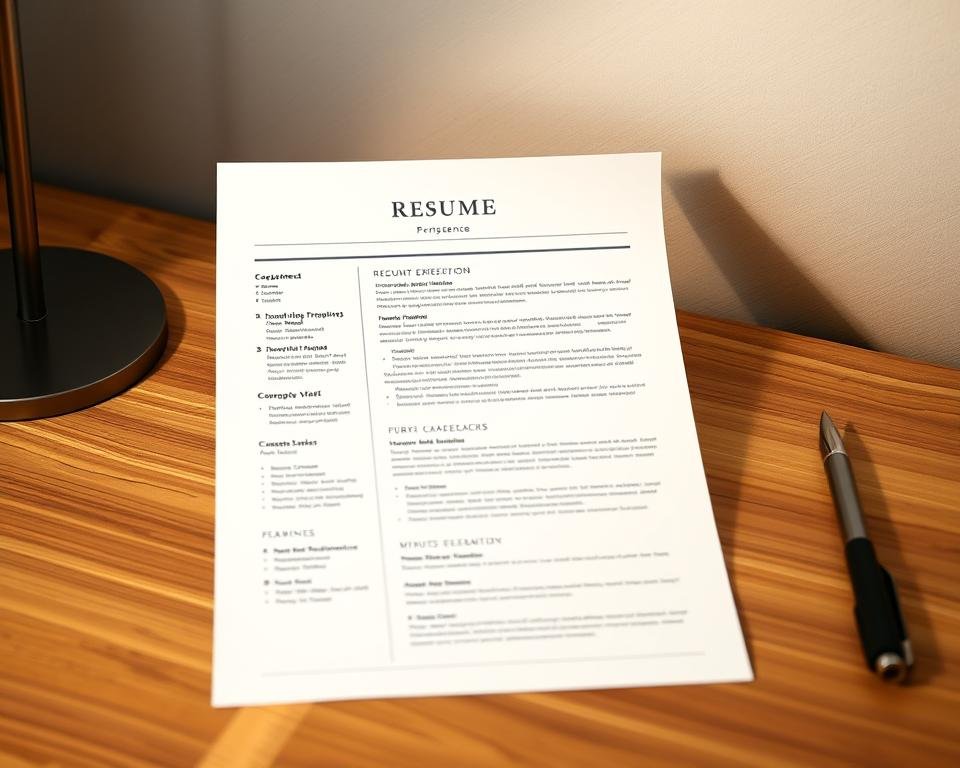
Having a clear structure makes your resume easy to scan. Organize it into sections like ‘Work Experience,’ ‘Education,’ and ‘Skills.’ Use bold headings to separate sections and help hiring managers find what they need.
- Start with your contact info at the top.
- Then, add a professional summary or career summary.
- List your work experience in reverse chronological order.
White Space and Margins
Using white space and margins well makes your resume easier to read. Avoid too much information. Use white space to keep your resume clean and professional.
- Keep margins of at least 0.5 inches on all sides.
- Use bullet points to break up text.
- Keep your resume short, ideally one to two pages.
By focusing on these formatting tips, you can make a resume that highlights your skills and career. This will make you more appealing to employers.
Demonstrating Achievements Over Duties
A strong resume shows what you’ve done, not just what you did. It highlights your skills and what you can do for a company. This makes it clear how you can help their business grow.
Quantifying Results: Why It Matters
Showing your achievements with numbers is key. It proves you can do the job well. For example, saying “increased sales by 25%” shows your impact better than just “increased sales.”
Key benefits of quantifying results include:
- Making your achievements more credible and tangible
- Providing a clear measure of your impact
- Helping your resume stand out in a competitive job market
Examples of Strong Achievement Statements
Here are some examples of strong achievement statements:
| Weak Statement | Strong Statement |
|---|---|
| Responsible for managing a team. | Led a team of 10 members, achieving a 30% increase in productivity. |
| Handled customer complaints. | Resolved customer complaints, resulting in a 25% reduction in complaint rates. |
| Worked on improving sales figures. | Increased sales by 15% within 6 months through targeted marketing strategies. |
By focusing on achievements and using numbers, you make your resume more compelling. It shows your skills and qualifications in a clear way.

The Role of Keywords in Resumes
Keywords are key to getting your resume noticed. They help your resume pass through applicant tracking systems (ATS) and catch the eye of hiring managers. Keywords are the words and phrases most relevant to the job you’re applying for.
To make your resume work best, find and use the right keywords. This means understanding the job description and requirements. Then, tailor your resume using that knowledge.
Identifying Relevant Keywords
Start by analyzing the job posting carefully. Look for words or phrases that are repeated. Also, note the skills and qualifications mentioned. These are often what ATS systems look for.
Using industry-specific terms is also smart. It helps with ATS and shows your expertise to hiring managers.
| Keyword Source | Example Keywords | Benefits |
|---|---|---|
| Job Postings | Project management, team leadership, data analysis | Tailors your resume to the job, improving ATS compatibility |
| Industry Terminology | Agile methodologies, digital marketing, cloud computing | Demonstrates expertise and familiarity with industry-specific concepts |
Integrating Keywords Naturally
After finding the right keywords, put them into your resume naturally. Don’t stuff your resume with keywords. It can look unnatural and might get flagged by ATS.
Instead, add keywords to your summary, work experience, and skills section. Use them to describe your achievements and responsibilities.
For example, if a job wants “data-driven decision making,” use this phrase in your summary or work experience. It shows you meet the job’s needs.
By using keywords wisely, you can make your resume more visible. This increases your chances of getting an interview.
Handling Employment Gaps
Many job seekers face challenges with employment gaps. These gaps can be due to health issues, caregiving, or unemployment. It’s hard to deal with them in a resume or CV.
But, it’s important to face this issue head-on. Employers might doubt unexplained gaps. Being proactive and strategic is key.
Strategies to Address Gaps Effectively
Being honest and brief about the gap is a good strategy. You don’t have to share too much. A simple explanation can help. For example, you might say you were caring for a family member or studying.
A table summarizing possible explanations and their impacts is below:
| Reason for Gap | Example Explanation | Positive Spin |
|---|---|---|
| Education/Training | “Took time off to pursue a certification course.” | Highlights proactive skill development. |
| Health Issues | “Took a break due to health reasons, now fully recovered.” | Shows resilience and recovery. |
| Caregiving | “Took a career break to care for a family member.” | Demonstrates responsibility and compassion. |
Focusing on Transferable Skills
It’s vital to highlight skills you’ve kept or gained during the gap. Skills like communication, problem-solving, or leadership are useful everywhere. They show you can adapt and lead.
For instance, if you volunteered or freelanced, mention it. These experiences show your dedication and skills.
By focusing on transferable skills and addressing the gap, you can show your flexibility and strength.
Proofreading and Editing Your Resume
After you’ve made your resume, it’s time to check it carefully. A small mistake can hurt your chances of getting a job. It might even stop you from getting an interview.
Editing is more than fixing errors. It’s about making your resume look great. This way, your professional profile will show off your skills and experiences well.
Common Errors to Avoid
Look out for these common mistakes in your resume:
- Typos and grammatical mistakes
- Inconsistent formatting
- Inaccurate or outdated information
- Poorly written or vague career summary
Take a break before you review your resume. This helps you see it with fresh eyes. Reading it out loud can also catch errors and awkward parts.
| Error Type | Description | Correction Tip |
|---|---|---|
| Typos | Spelling mistakes | Use spell check and proofread carefully |
| Formatting Issues | Inconsistent font, size, or spacing | Use a consistent style throughout |
| Outdated Information | Old work experience or skills | Regularly update your resume |
Seeking External Feedback
Getting feedback from others can be very helpful. Friends, family, or career counselors can give you new ideas. They can also point out things you can improve.
Ask specific questions when you get feedback. For example:
- Is my professional profile clear and concise?
- Are my skills and experiences effectively showcased?
- Are there any sections that are confusing or unclear?
By combining your own editing with feedback, your resume will be top-notch. It will help you get your next interview.
How to Optimize Your Resume for Online Applications
To boost your hiring chances, optimize your resume for ATS. Many firms use Applicant Tracking Systems to sift through resumes before a human recruiter sees them. If your resume isn’t optimized, it might not get noticed.
Knowing how ATS work is key. These systems filter resumes based on employment history and skills and qualifications. Tailor your resume to match the job description to increase your chances.
Understanding Applicant Tracking Systems
ATS are advanced software that help companies manage job postings and resumes. They automatically weed out unqualified candidates, making hiring easier.
To outsmart ATS, grasp how they operate. They search for keywords from the job description. So, include relevant terms in your resume, focusing on your skills and qualifications.
Best Practices for PDF vs. Word Formats
When applying online, you might choose between PDF and Word formats. Word documents are preferred by ATS because they’re easy to read.
PDFs can sometimes cause ATS problems, mainly if they’re not text-based. Yet, PDFs keep your resume’s look intact. Always check the job posting for file format instructions.
If unsure, save your resume in both formats. Make sure your employment history and skills and qualifications stand out in both.
Staying Updated: When to Revise Your Resume
As you keep looking for jobs, it’s key to keep your Resume current. A Resume that doesn’t change can hurt your chances of getting an interview. So, it’s important to update it often.
Recognizing the Need for a Refresh
If you’ve learned new skills, switched careers, or taken a break, it’s time to look at your Resume again. Signs you might need to update it include not getting any job responses or feeling like your experience isn’t being shown well.
Staying Current with New Skills
To stay ahead, I always update my Resume with new skills and experiences. I check my summary, organize sections, and make sure my achievements are clear and highlighted.
By keeping your Resume fresh and focused on your job search goals, you’ll be ready for new chances that come up.
